

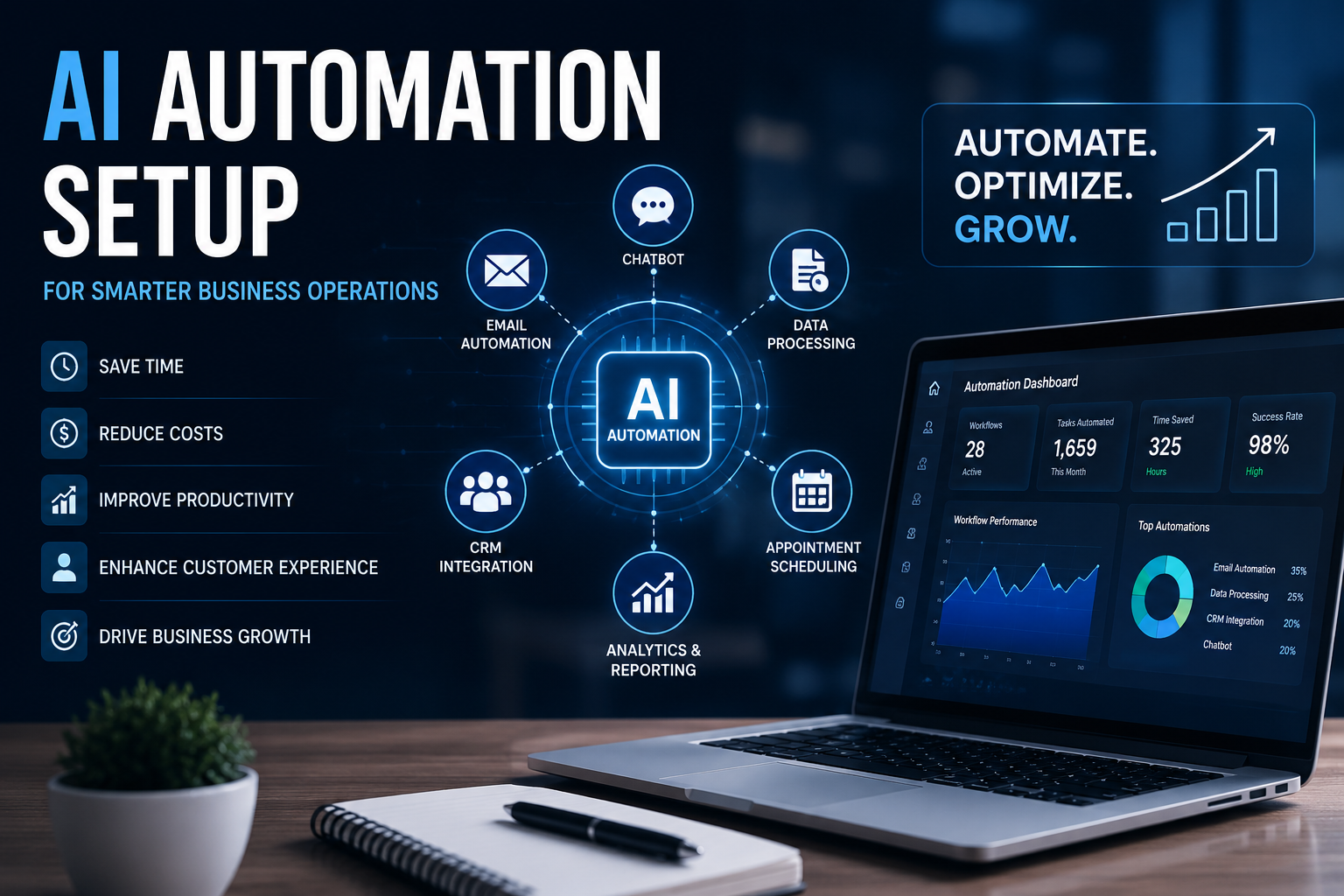
In today’s fast-paced digital landscape, businesses are constantly looking for ways to improve efficiency, reduce operational costs, and enhance customer experiences. AI automation has emerged as a game-changing solution, enabling organizations to automate repetitive tasks, streamline workflows, and make data-driven decisions with minimal human intervention.
Whether you’re a startup, small business, or enterprise organization, implementing a well-structured AI automation setup can significantly boost productivity and drive sustainable growth.
What is AI Automation?
AI automation combines Artificial Intelligence (AI) technologies with automated workflows to perform tasks that traditionally require human effort. Unlike standard automation, AI-powered systems can learn from data, recognize patterns, make predictions, and continuously improve performance.
Common AI automation applications include:
- Customer support chatbots
- Lead generation and qualification
- Email marketing automation
- Data entry and processing
- Appointment scheduling
- Sales pipeline management
- Content generation and optimization
- Business process automation
Benefits of AI Automation Setup
1. Increased Productivity
AI automation eliminates repetitive and time-consuming tasks, allowing employees to focus on strategic and high-value activities.
2. Cost Reduction
Automated systems reduce labor costs, minimize errors, and optimize resource allocation across departments.
3. Enhanced Customer Experience
AI-powered chatbots and virtual assistants provide instant responses, personalized recommendations, and 24/7 customer support.
4. Improved Accuracy
AI systems process large volumes of data with greater precision, reducing human errors and ensuring consistency.
5. Scalability
As your business grows, AI automation can easily handle increased workloads without requiring proportional increases in staff.
Key Components of an AI Automation Setup
AI-Powered Data Collection
The foundation of successful automation begins with collecting and organizing business data from multiple sources, including:
- CRM systems
- Websites
- Social media platforms
- Email campaigns
- Customer interactions
Workflow Automation Engine
Automation tools connect different applications and create seamless workflows that execute predefined actions automatically.
Examples include:
- Lead capture to CRM integration
- Automated follow-up emails
- Customer onboarding sequences
- Invoice generation and processing
Machine Learning Models
Machine learning algorithms analyze historical data to generate insights, predictions, and recommendations that improve business performance.
Monitoring and Optimization
Regular monitoring ensures automated workflows continue performing efficiently while identifying opportunities for improvement.
AI Automation Setup Process
Step 1: Identify Business Processes
Start by identifying repetitive tasks that consume significant time and resources.
Examples include:
- Customer support requests
- Data entry
- Appointment scheduling
- Sales follow-ups
- Reporting tasks
Step 2: Define Automation Goals
Establish clear objectives such as:
- Reducing operational costs
- Improving response times
- Increasing lead conversions
- Enhancing customer satisfaction
Step 3: Select the Right AI Tools
Choose AI solutions that align with your business needs and integrate seamlessly with existing systems.
Popular categories include:
- AI chatbots
- Workflow automation platforms
- CRM automation tools
- AI content generation tools
- Predictive analytics platforms
Step 4: Integrate Systems
Connect all relevant applications, databases, and communication channels to create a unified automation ecosystem.
Step 5: Train and Test
Before deployment, thoroughly test workflows and train AI models using relevant business data to ensure optimal performance.
Step 6: Launch and Monitor
Deploy your automation system and continuously monitor key performance metrics to identify improvements and maximize ROI.
Popular AI Automation Use Cases
Customer Support Automation
AI chatbots can answer common questions, resolve basic issues, and escalate complex inquiries to human agents when necessary.
Sales Automation
Automate lead qualification, follow-up sequences, appointment booking, and customer relationship management.
Marketing Automation
AI can optimize campaigns, segment audiences, personalize messaging, and generate content for improved engagement.
HR Automation
Streamline recruitment, employee onboarding, document management, and internal communication processes.
Finance Automation
Automate invoice processing, expense tracking, financial reporting, and compliance management.
Challenges to Consider
While AI automation offers numerous benefits, businesses should be aware of potential challenges:
- Data quality issues
- Integration complexities
- Employee adoption and training
- Security and privacy concerns
- Initial implementation costs
Proper planning and expert guidance can help overcome these challenges and ensure successful implementation.
Why Businesses Are Investing in AI Automation
Organizations worldwide are embracing AI automation to stay competitive in an increasingly digital marketplace. Companies that adopt intelligent automation gain advantages through:
- Faster operations
- Better customer engagement
- Reduced overhead costs
- Improved decision-making
- Increased revenue opportunities
As AI technology continues to evolve, automation will become an essential component of modern business strategies.
Conclusion
An effective AI automation setup empowers businesses to work smarter, operate more efficiently, and deliver exceptional customer experiences. From automating routine tasks to enabling intelligent decision-making, AI-driven solutions provide measurable benefits across every department.
Businesses that invest in AI automation today position themselves for long-term growth, scalability, and success in an increasingly competitive digital environment.